The human mind perceives itself as an uninterrupted flow of consciousness, a linear narrative that continues from waking to sleeping.
However, contemporary science and modern physics suggest a different reality: our mental existence is, in essence, discrete and fragmented.
Historically, it was estimated that we processed between 6,000 and 60,000 thoughts daily.
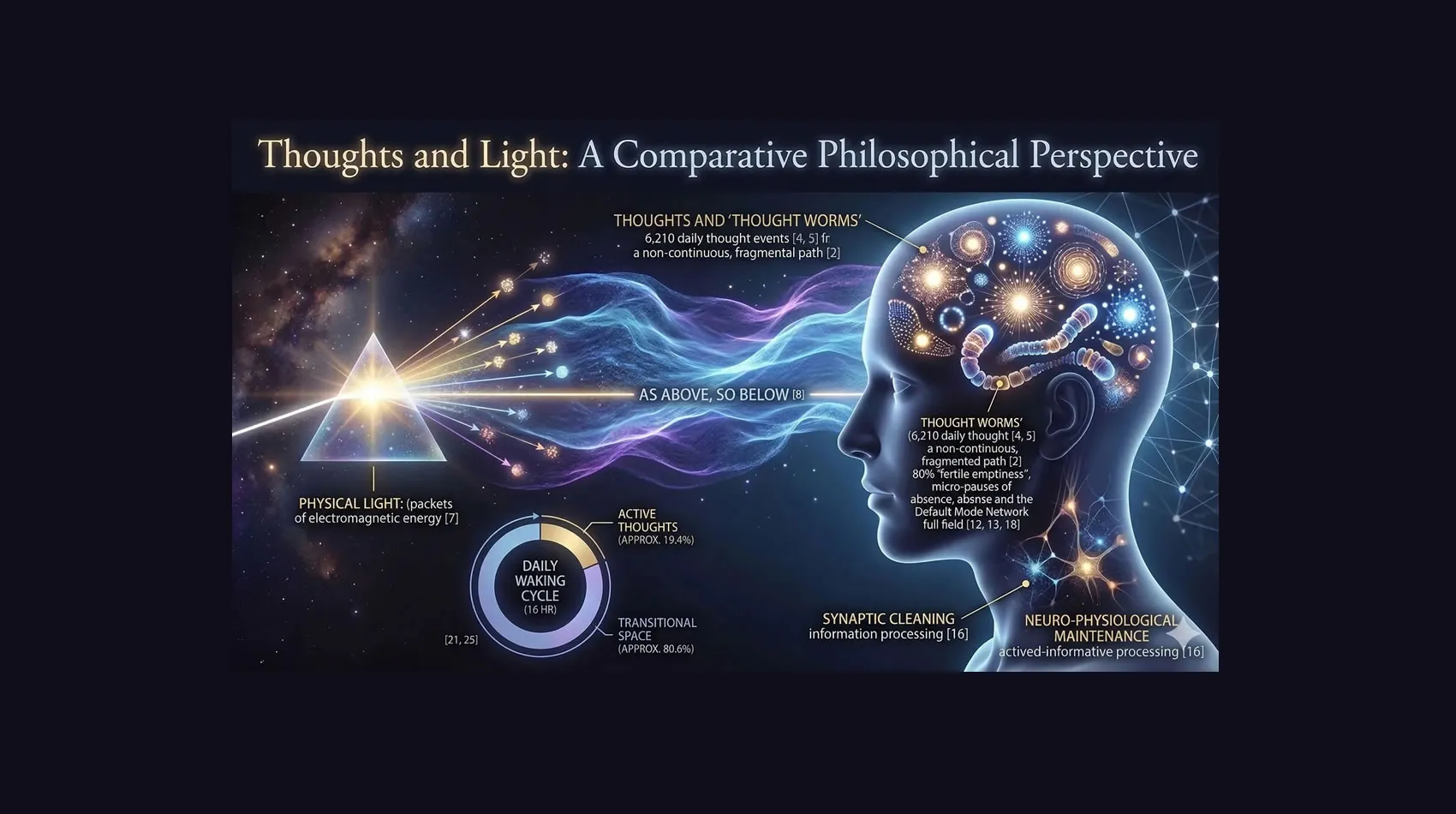
However, recent functional neuroimaging studies have refined this view by identifying so-called “thought worms,” patterns that allow us to precisely delineate where one idea ends and the next begins.
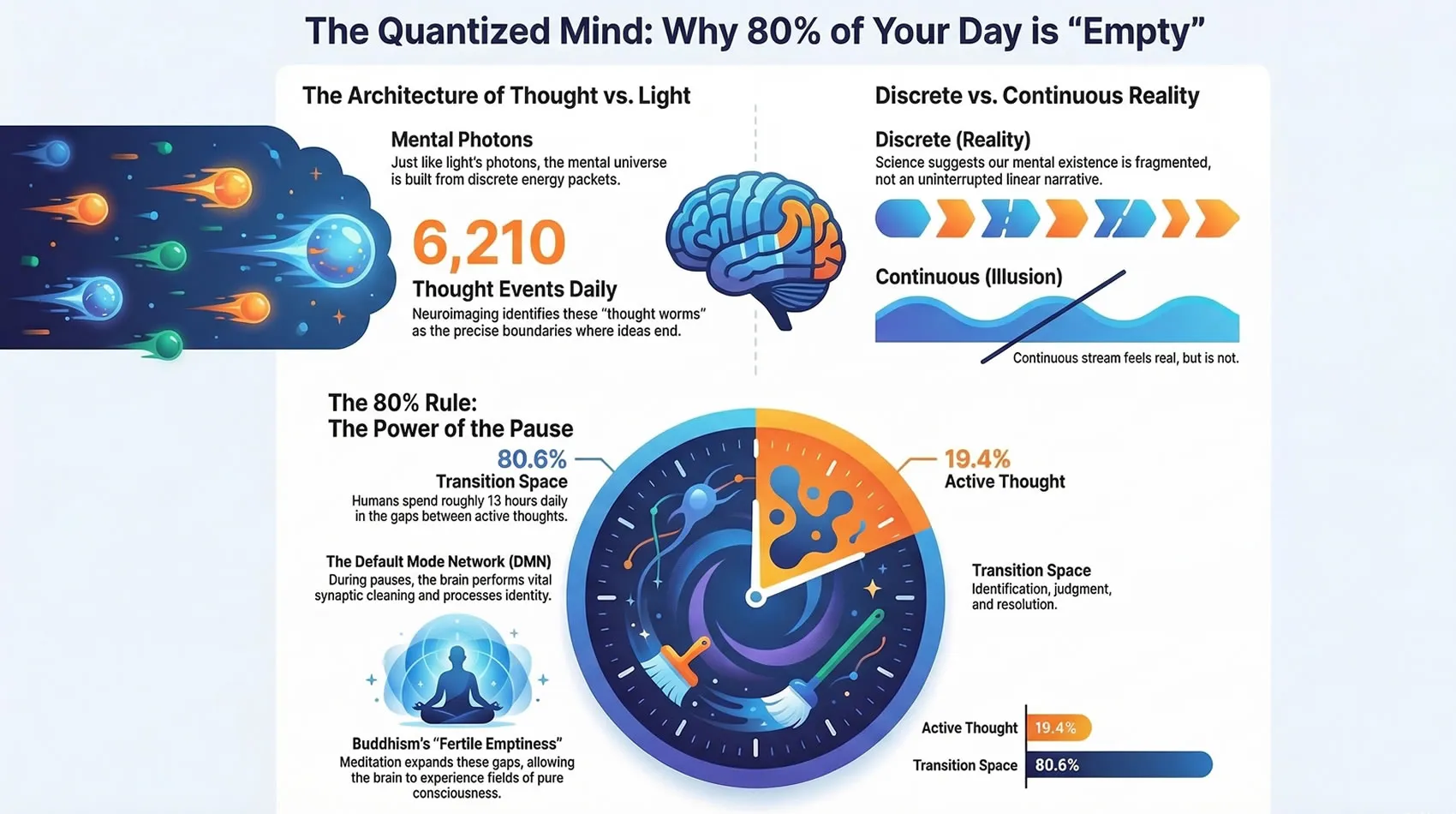
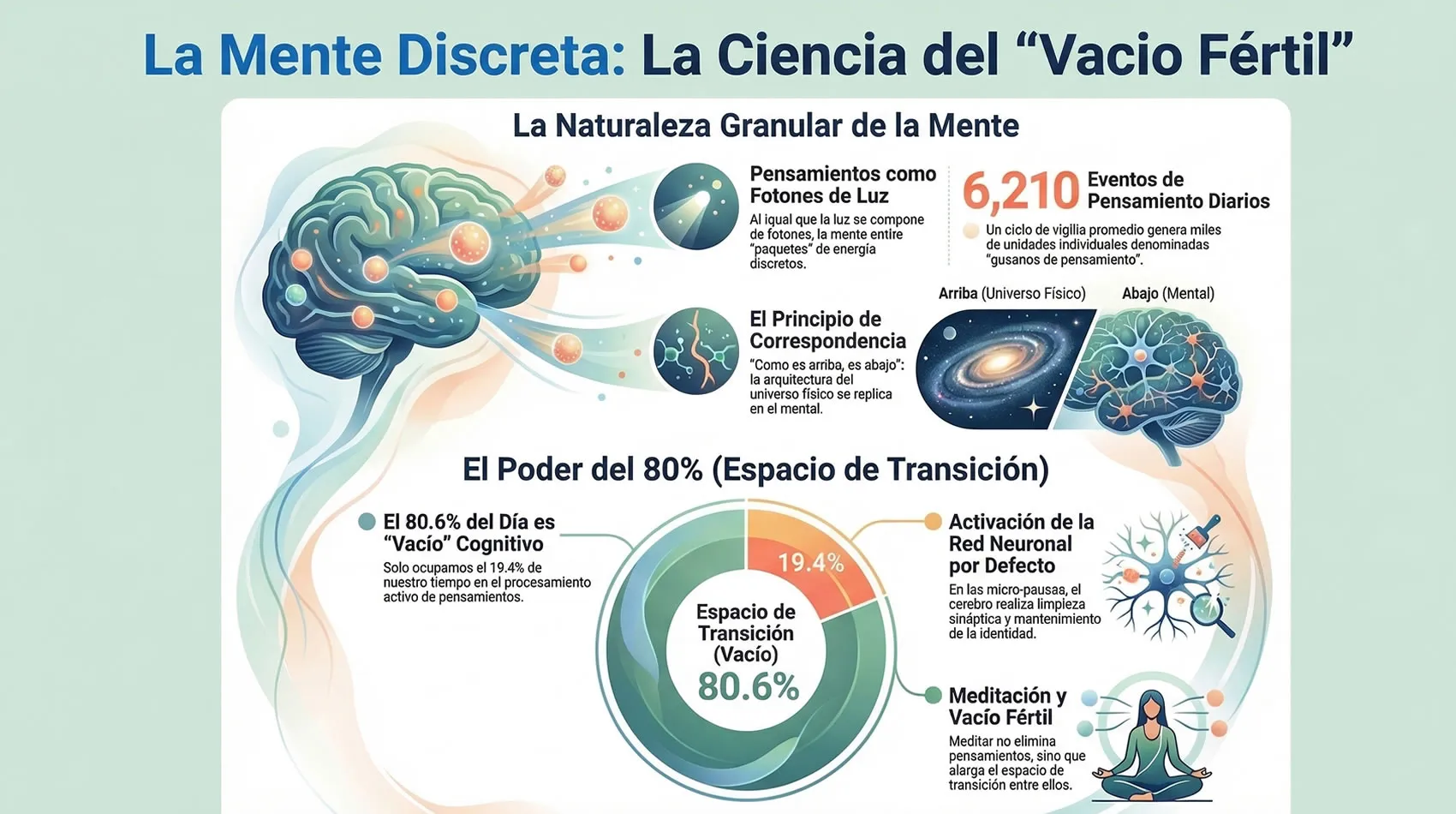
Under this transitional model, an average person generates approximately 6,210 thought events in a waking cycle.
The Granular Nature of Mind and Light
This intermittent structure finds its exact reflection in the nature of light.
Traditionally, we see light as a continuous beam, but physics has shown that it is composed of photons: discrete packets of electromagnetic energy.
This is where the Hermetic Principle of Correspondence—”As above, so below”—takes on astonishing scientific relevance.
If light, the basis of energy in the physical universe, is discontinuous, the mind (the mental universe) replicates that same architecture.
Just as with photons, the space between our thoughts is not absolute nothingness, but a field of influence.
If we analyze the duration of these 6,210 thoughts compared to the 16 hours we are awake, we are confronted with a fascinating mathematical reality:
Cognitive “noise” occupies only a fraction of the day. The rest of the time—approximately 80% of our waking hours—consists of micro-pauses of absence.
What happens in that 80% of apparent nothingness?
Science has discovered that the brain consumes almost as much energy during these intervals as when we are actively thinking.
This phenomenon corresponds to the activation of the Default Mode Network (DMN).
During these hours of accumulated micro-pauses, the brain is not inactive; it is in a maintenance state, processing identity and performing synaptic “cleaning.”
Without this “space” of disconnection, the nervous system would collapse from information overload.
What Buddhism calls the “fertile emptiness” is, technically, the conscious habituation of these micro-pauses.
When meditating, we don’t eliminate mental “photons,” but rather lengthen the transition space between them, allowing the perception of time to be altered and the brain to experience the continuous field of pure consciousness.
Appendix: Mathematical Analysis and Mental Chronometry
To validate the claim that 80% of our waking hours are transitional time, we break down the data based on mental chronometry and neurophysiology:
Definition of Variables:
Standard wakefulness cycle: 16 hours (960 minutes or 57,600 seconds).
Thought events: 6,210 (according to the Queen’s University study).
Average duration of a thought (D_p): In neuroscience, a cognitive process (identification, judgment, and resolution) has an integration window of between 1.5 and 2 seconds.
Calculation of Cognitive Occupation Time (Toc):
Toc = 6,200 x 1.8 seconds per thought = 11,178 seconds.
Calculation of the Percentage of Occupation vs. Empty:
Active mental occupation:
(11,178/57,600) x 100 = approx. 19.4%
Transition space (Empty):
100% – 19.4% = 80.6%
Although we subjectively feel that we are thinking all the time, physiologically we spend 80% of our waking life in transitional states between packets of information. It is in this 80% that the potential for mindfulness resides.
References
Planck, M. (1900). On the Theory of the Law of Energy Distribution in the Normal Spectrum. Annalen der Physik.
Posner, M. I. (2005). Timing the Brain: Mental Chronometry as a Tool in Neuroscience. PLoS Biology.
Raichle, M. E. (2015). The Brain’s Dark Energy. Scientific American.
Three Initiates. (1908). The Kybalion. Kier Publishing.