Literature, Cultural
Pandora’s Box of the Self: Self-Awareness

July 30, 2026
Share:
To understand the ethical and existential dilemma of the human being, it is essential to draw a conceptual distinction between consciousness and self-awareness, and to establish how profoundly this sets us apart from animals.
For millions of years, life evolved according to the strict, blind laws of nature; within this vast process, species endowed with intelligence, memory, and cooperation emerged.
Many animals possess forms of perceptual consciousness, sensory processing, and complex adaptive responses that allow them to interact with their environment.
Yet at some critical point in evolution, something radically new emerged: self-awareness — a being capable not only of feeling and reacting, but of observing itself, of knowing itself to be alive, and of uttering the primordial pronoun, “I.”
Far from being a fixed destiny or an instinctive program, self-awareness acts as a prism that refracts reality into infinite moral directions.
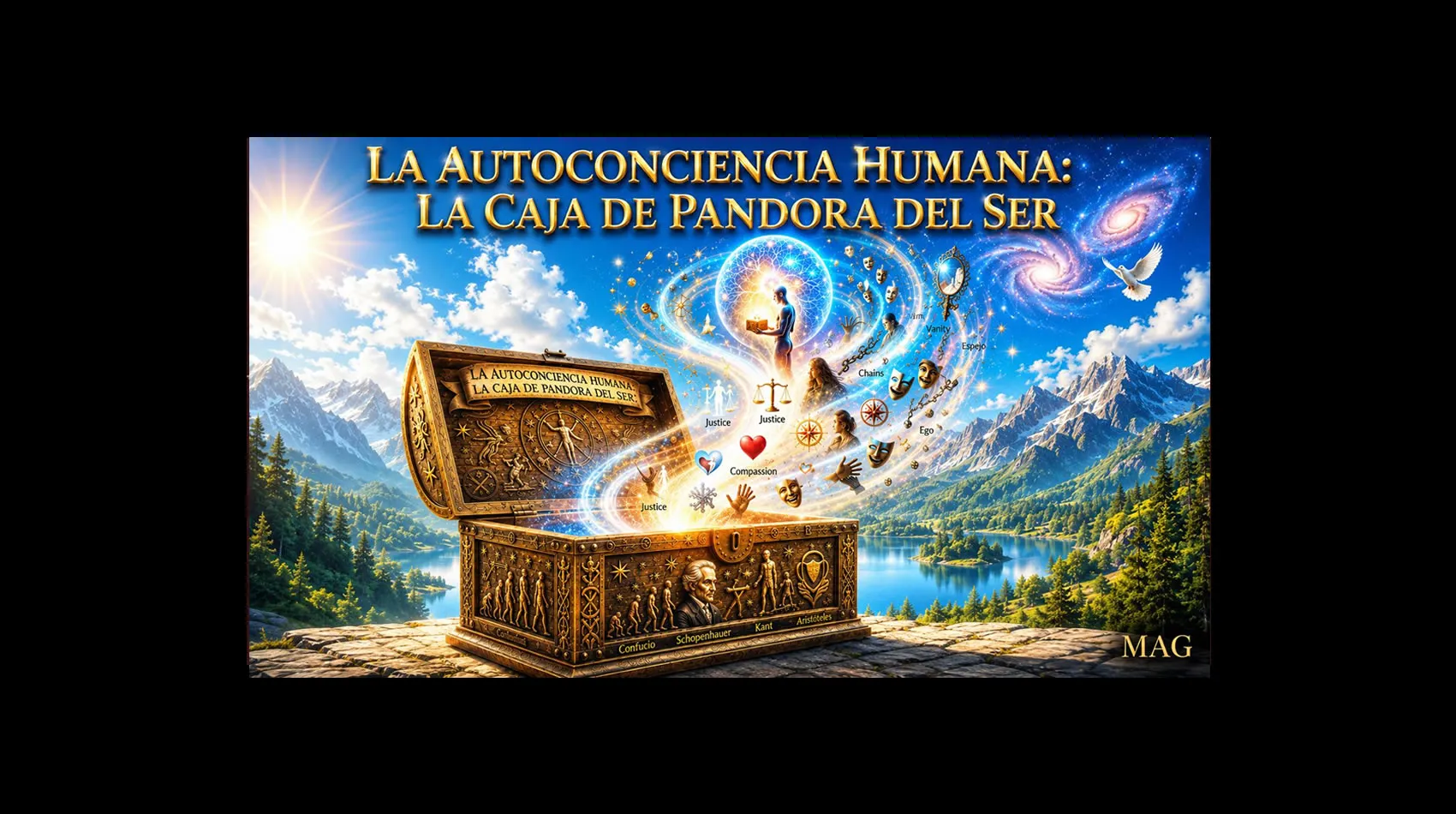
Like the mythical Pandora’s Box — the famous myth recorded by Hesiod (8th century BC) in Works and Days, in which the first mortal woman opens a great jar that releases all the evils of the world, leaving only hope confined within — so too does human self-awareness function.
Self-awareness dictates no single path; instead, it throws every path wide open: with it are born the possibility of justice, solidarity, and selfless love, but also the corrosive shadow of selfishness, vanity, guilt, and hatred.
The birth of the “I” inaugurated individual identity, but it inevitably brought with it its twin shadow: appropriation and narcissism.
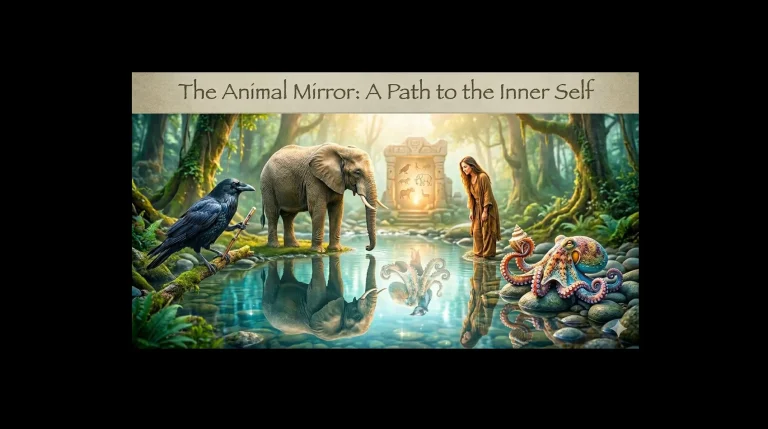
This condition finds its classic archetype in the myth of Narcissus, the beautiful young man of Greek mythology — masterfully popularized by Ovid in his Metamorphoses (8 AD) — who, having spurned the love of the nymph Echo and other suitors, was condemned by the gods to fall hopelessly in love with his own unreachable reflection in the crystalline waters of a spring.
Unable to tear his gaze from himself, Narcissus consumed his life in a tunnel of sterile fascination until he wasted away and was transformed into the flower that bears his name.
This myth precisely illustrates the primordial danger of self-awareness: in becoming conscious of its own existence, the human being runs the constant risk of becoming captivated by its own reflection, sealing itself within a sterile cult of the ego.
Upon perceiving itself as separate from the rest of the universe, it stopped merely inhabiting its environment and began to fragment it under the rigid categories of the “mine” and the “other”:
Thinking in terms of “my body, my ideas, my wealth” turned the ego into a walled fortress ruled by narcissism.
Possession ceased to be strictly biological and became a mental and spiritual refuge against the harshness of the void, opening the door to greed as a mechanism of existential defense.
In order to understand and navigate this constitutive tension, Western thought has traced fundamental paths that attempt to decipher the dilemma of self-awareness:
For Baruch Spinoza (1677), every being in nature possesses a natural, incessant, and tireless drive to persevere in its own existence; this vital dynamism is what he called conatus.
In its ontic origin, this is not a moral defect nor an intrinsic evil, but the pure affirmation of life.
The ethical problem arises when the individual absolutizes that drive, falling into narcissistic isolation and forgetting its deep connection with the whole of nature and with fellow beings.
The more we understand our intrinsic unity with the cosmos and with others, the more our consciousness expands and the smaller the dominion of blind selfishness becomes.
Arthur Schopenhauer (1819, 1841) argues that the entire universe is driven by a blind, voracious, and desperate will that seeks perpetually to affirm itself.
Human selfishness is the clearest manifestation of this impersonal force.
However, the philosopher introduces a luminous turn: compassion breaks the hermetic circle of the self.
If we are able to look at the other and recognize in their suffering our own shared reality, the barriers of individuality and narcissistic enclosure collapse.
Transcending selfishness is not the result of a rational calculation, but of a profound metaphysical intuition of the unity of universal pain.
Immanuel Kant (1785) holds that consciousness only reaches true maturity and fullness when it renounces mere utilitarian interest in favor of universal principles.
The categorical imperative calls us to act in such a way that we treat humanity — whether in our own person or in that of any other — always as an end in itself, and never merely as a means.
Moral freedom, therefore, requires subjecting the appetite of the ego and the arrogance of narcissism to the rigor of the universal law of duty and respect.
Long before, Aristotle (4th century BC) understood that the human being is constitutively a political animal, whose self-realization cannot be conceived in isolation.
The fullness of consciousness is not achieved by yielding to the unchecked whim of every desire nor to the cult of individualism, but by patiently cultivating character (ethos) through the exercise of virtue within the living heart of the community.
It is the education of habits that shapes a soul capable of aspiring to the common good.
Ultimately, perceptual and instinctive consciousness links us to the rest of the animal kingdom, but it is the emergence of self-awareness that marks the radical boundary separating us from them, inaugurating the realm of moral deliberation.
Self-awareness is, in the end, evolution’s greatest gift and, simultaneously, its most overwhelming responsibility.
Nature did not create only the possibility of isolation, narcissism, and selfishness; it created the radical freedom to choose between vanity and compassion, between the enclosure of the self and the expansion of love.
Pandora’s Box remains irrevocably open in the heart of every human being.
Our historical, ethical, and existential task does not consist in trying to close it — which would amount to renouncing our own self-aware condition — but in learning to govern its contents with wisdom, clarity, and empathy.