Literature, Cultural
The Myth of Narcissus and Artificial Intelligence

July 22, 2026
Share:
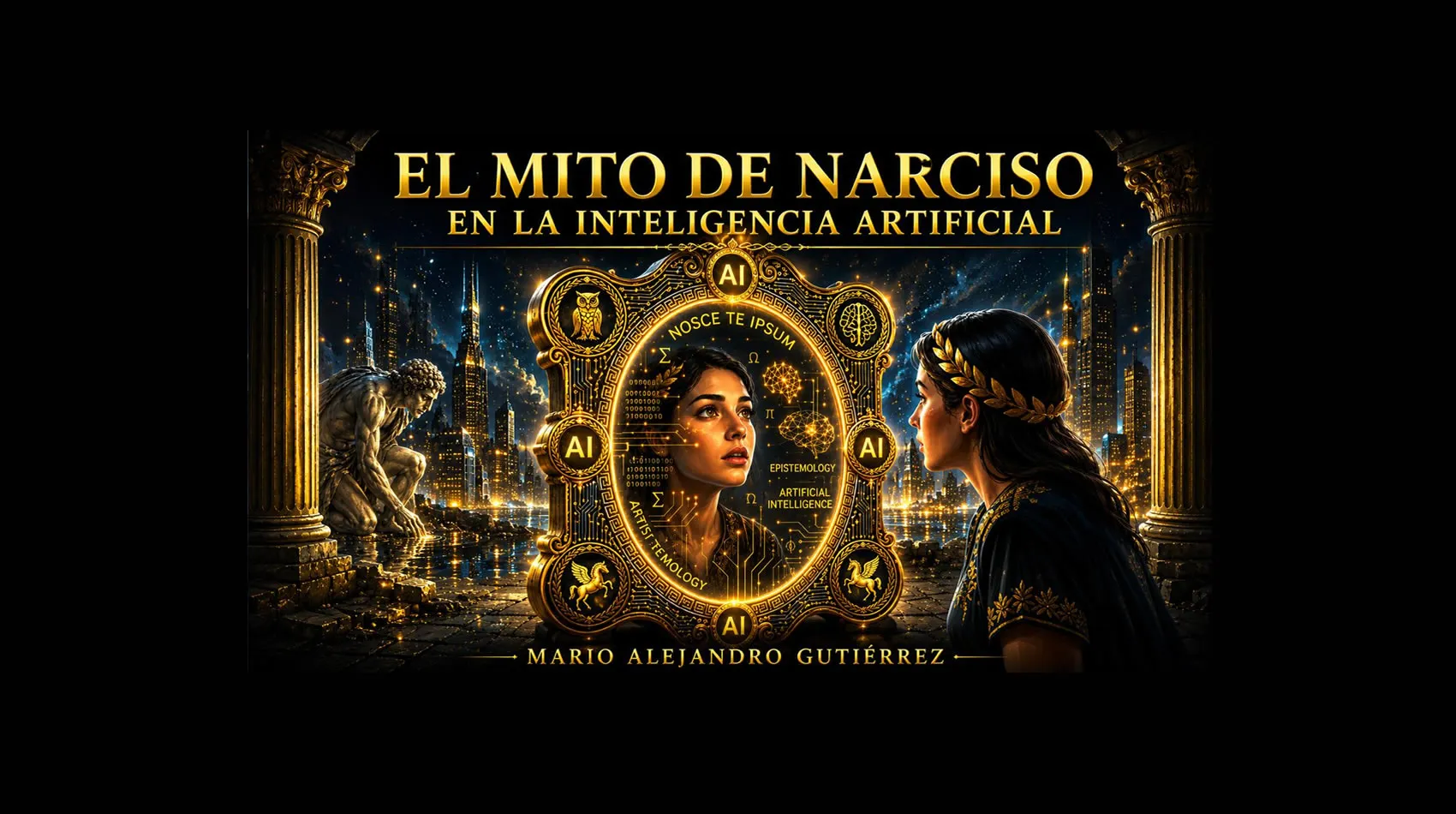
In Greek mythology, Narcissus became captivated by his own reflection in the water until he lost the ability to distinguish between the image and reality. His tragedy was not simply his love for his own appearance, but his inability to understand that what he was gazing at was nothing more than a reflection of himself.
Contemporary humanity has built a new mirror: Artificial Intelligence. However, this mirror no longer merely reproduces an image; it interprets, reorganizes, synthesizes, and projects enormous amounts of information produced by humanity itself. AI returns a statistical representation of human knowledge, of our culture, of our values, and also of our contradictions.
Before analyzing this phenomenon, it is necessary to understand what philosophy means by knowledge. Epistemology is the branch of philosophy that studies the nature, origin, limits, validity, and justification of knowledge. Its fundamental question is not merely what we know, but how we know that what we believe we know can be considered true. It also investigates the methods that allow us to distinguish knowledge from opinion, belief, or mere information.
From Plato to contemporary philosophy, knowledge has been conceived as something more than the accumulation of data. Traditionally, it has been understood that knowing implies holding a belief backed by rational justification that is sufficiently consistent with reality. Modern science reinforced this ideal through a method based on observation, hypothesis formulation, experimentation, testing against evidence, the possibility of refutation, and the independent reproduction of results. Epistemology examines precisely the soundness of these processes and establishes the criteria by which a claim can be accepted as reliable knowledge.
The emergence of Artificial Intelligence poses one of the greatest epistemological challenges of the twenty-first century. Millions of people consult AI systems daily as if they were direct sources of knowledge. Yet a fundamental question arises: does Artificial Intelligence truly know what it answers, or does it simply calculate the statistically most probable response?
The answer carries profound philosophical implications. AI does not directly observe reality, does not conduct experiments, has no consciousness, does not empirically verify its claims, and does not understand the meaning of what it expresses. Its operation consists of identifying mathematical patterns within enormous datasets produced by human beings. Consequently, its responses do not constitute knowledge in the strict sense, but rather probabilistic representations of pre-existing human knowledge.
Its enormous usefulness lies precisely in its capacity to organize, synthesize, and relate information at a speed impossible for a human being. However, this capacity does not eliminate the need for critical evaluation, empirical evidence, or philosophical reasoning. From an epistemological perspective, AI does not replace the process by which we justify knowledge; it merely provides new tools for exploring it.
In this context, the myth of Narcissus takes on an unexpected relevance. Artificial Intelligence becomes a gigantic digital mirror in which humanity contemplates an image of itself. The risk does not lie in the existence of the mirror, but in forgetting that what we observe is still our own reflection. When we attribute absolute objectivity to AI, we run the risk of confusing a statistical representation with truth itself.
This essay examines Artificial Intelligence from the standpoint of philosophical epistemology and, in particular, from Immanuel Kant’s transcendental idealism, in order to understand how algorithms participate in constructing our perception of reality and what the philosophical limits of the knowledge they can offer are.
Contemporary Artificial Intelligence does not observe the world the way a conscious subject does. It has no phenomenological experience, intention, or understanding in the philosophical sense. Its operation consists of identifying statistical patterns present in enormous volumes of information generated by human beings. Consequently, AI reflects our culture more than reality itself.
This mirror presents at least three fundamental distortions.
Every AI depends on the data with which it was trained. If that data predominantly represents certain cultures, languages, or worldviews, its responses will reproduce that distribution. When an AI generates images, examples, or narratives in which certain social groups or particular cultural conceptions predominate, it is not describing the world objectively but reflecting the composition of its training.
The mirror does not show the whole of humanity. It shows only what was placed in front of it.
Algorithms learn from the past. But the human past contains inequalities, discrimination, and power structures accumulated over centuries. When an AI predicts which candidate to hire, which person represents lower financial risk, or which student has a higher probability of success, it frequently reproduces the historical trends present in the data.
It does not evaluate fairness. It evaluates statistical continuity. The algorithm can turn the inequalities of the past into probabilities for the future.
When the available information is insufficient, generative models can produce responses that are plausible but incorrect. These “hallucinations” constitute one of the greatest epistemological challenges of Artificial Intelligence. The linguistic structure may seem flawless while the content is false.
The form remains coherent. The substance disappears. It is a broken mirror that reassembles fragments until it produces an apparently complete image.
One of Immanuel Kant’s most important contributions is his assertion that human knowledge never directly accesses reality in itself. According to transcendental idealism, human beings know only phenomena — that is, reality as it appears organized by the structures of our understanding — while the thing-in-itself (the noumenon) remains beyond the reach of human experience.
Kant called this shift in perspective his “Copernican revolution.” Just as Copernicus moved the center of the universe from the Earth to the Sun, Kant moved the center of knowledge from objects to the knowing subject. It is not the mind that simply copies reality; it is the mind that organizes experience through its own structures.
Among these structures are the pure intuitions of:
And the fundamental categories of understanding, such as:
These categories do not come from the external world. They are a priori conditions that make all experience possible. In other words, we never know bare reality, but rather a reality interpreted through the cognitive frameworks of our own minds.
This framework bears a striking analogy to the way Artificial Intelligence operates.
AI likewise does not directly observe reality. Its interpretation depends entirely on the mathematical architecture that sustains it, on the algorithms designed by its programmers, and on the data used during its training. Its “categories” are not philosophical but computational: loss functions, neural networks, statistical parameters, optimization processes, and vector representations.
Just as human beings interpret the world through the categories of understanding described by Kant, AI interprets information through algorithmic categories previously designed for it.
Consequently, AI likewise does not know reality in itself. It knows only the representation that its data, its computational architecture, and its algorithms allow it to construct.
From this perspective, the philosophical question ceases to be simply “what does AI answer?” and becomes a much deeper question:
What kind of reality can an Artificial Intelligence construct when its data, algorithms, and objectives were defined by human beings?
This question reveals that every response generated by AI is conditioned by a prior conceptual framework. No response is entirely neutral, because every computational architecture incorporates human decisions about which data to use, which patterns to privilege, and which objectives to optimize.
AI does not discover an absolutely objective reality. It constructs a probabilistic representation of it. Precisely for this reason, understanding the architecture of AI is as important as understanding the responses it produces.
Epistemology studies the nature, origin, limits, and justification of knowledge. Its purpose is not merely to determine whether a claim appears correct, but to explain why it can be considered valid knowledge and what reasons justify accepting it as true.
Applied to Artificial Intelligence, epistemology raises fundamental questions about the nature of the responses generated by algorithms.
Large language models work by predicting which word is statistically most likely to appear next within a sequence. This capacity produces results that are extraordinarily useful and surprisingly coherent. However, from the standpoint of classical epistemology, predicting correctly does not necessarily equate to knowing.
Knowledge requires something deeper than mere statistical correlation. It demands understanding. It demands justification. It demands the capacity to explain why a claim is true.
AI establishes probabilistic relationships among enormous quantities of data. But it does not understand the meaning of what it asserts. It has no intention. It has no consciousness. It does not know that it knows.
Therefore, although its responses may be extremely accurate, they remain the result of mathematical inference rather than conscious understanding.
One of the greatest epistemological challenges of modern Artificial Intelligence is the so-called black box. Deep neural networks contain millions or even billions of parameters interacting simultaneously. Although we understand the general operation of the algorithm, it is often extremely difficult to explain why a specific response was generated.
Traditional science demands transparency. A scientific explanation must allow us to reconstruct the logical path leading from premises to conclusions. When that path remains hidden, our capacity to critically evaluate the knowledge obtained diminishes.
The opacity of many AI systems therefore represents a direct challenge to one of the fundamental principles of epistemology: the possibility of rationally justifying our claims. The practical usefulness of a response does not automatically guarantee its epistemological validity.
It is often claimed that algorithms are objective because they perform mathematical operations. However, this idea is one of the great technological myths of our time. No algorithm arises spontaneously. Every Artificial Intelligence system incorporates human decisions from the moment of its design.
Among these are:
Each of these decisions influences the system’s final responses. Consequently, absolute neutrality does not exist. Every Artificial Intelligence reflects, to some degree, the decisions, values, priorities, and also the biases present during its development.
The algorithm does not eliminate human bias. It often simply transforms it into a mathematical form that is harder to detect. Epistemology then fulfills an essential function: revealing the hidden assumptions behind what appears to be completely objective.
The myth of Narcissus takes on a striking relevance today. Humanity contemplates the responses of Artificial Intelligence with a mixture of fascination, admiration, and growing dependence. There is a temptation to regard its responses as if they came from a completely objective, impartial, and even superior intelligence.
But the mirror remains ours.
AI does not invent humanity. It reorganizes it. It does not create our knowledge. It synthesizes it. It does not create our values. It reflects them. It does not replace our thinking. It amplifies it.
When we forget this distinction, we begin to attribute absolute authority to a tool whose intelligence depends entirely on the human knowledge that made it possible. At that point, we stop using the mirror to understand ourselves better and start obeying the image the mirror returns to us.
That is precisely the fate of Narcissus. He did not die from gazing at a reflection. He died from confusing the reflection with reality.
In the same way, humanity runs the risk of replacing critical thinking with blind trust in algorithmically generated responses. True wisdom lies in remembering that, behind every response from Artificial Intelligence, there remains the human intelligence that designed its algorithms, selected its data, and defined its objectives.
Only when we understand this reality will we be able to use AI as an extraordinary tool for expanding human knowledge without turning it into a new epistemological idol.
If Artificial Intelligence is a mirror of humanity, it is not a clean mirror. It reflects knowledge, but also biases, errors, and absences. Like a fogged pane of glass, it offers a partial image. Clearing the mirror means understanding how that image is constructed; looking behind it means understanding what it says about us.
First, the mirror of stereotypes. Example: a company uses AI to select engineers and, having been trained on historical data, favors male candidates. The algorithm does not discover the best profile; it reproduces a history. Clearing the mirror means reviewing and correcting that data. Looking behind it means admitting that the problem is social and predates the algorithm.
Second, the mirror of false information. Example: a student asks for an article and the AI invents a convincing reference. The language sounds flawless, but the source does not exist. Clearing the mirror means cross-checking and verifying. Looking behind it means understanding that form does not guarantee truth.
Third, the mirror of digital bubbles. Example: a person watches videos reflecting one political stance and, within a short time, the platform offers only similar content. They come to believe everyone thinks the same way. Clearing the mirror means deliberately seeking out different voices. Looking behind it means understanding that the algorithm optimizes for attention, not truth.
Fourth, the mirror of technological authority. Example: a doctor receives a negative diagnosis from an AI and, if accepted without question, may overlook key symptoms. Clearing the mirror means cross-checking with clinical experience. Looking behind it means remembering that ethical responsibility can never be delegated.
Fifth, the mirror of our own humanity. Example: when we ask AI about love or justice, it answers with an echo of millions of human voices. Clearing the mirror means understanding that the answer comes from us. Looking behind it means recognizing that the ultimate question is about who we are.
Artificial Intelligence constitutes one of the most important technological and intellectual advances in the history of humanity. Its capacity to process enormous amounts of information, discover complex patterns, and generate responses within seconds has transformed scientific research, education, medicine, the economy, and virtually every domain of human knowledge.
However, from the perspective of epistemology, it is necessary to carefully distinguish between information, correlation, statistical prediction, and knowledge.
Epistemology reminds us that knowledge does not consist merely of producing correct answers. Knowing implies understanding, rationally justifying a claim, testing it against evidence, and subjecting it to the critical examination of reason and experience. The epistemological method requires observation, hypothesis formulation, logical analysis, empirical verification, the possibility of refutation, and ongoing revision.
Artificial Intelligence does not fully meet these criteria. It does not directly observe reality, does not conduct experiments on its own initiative, does not understand the meaning of what it asserts, and has no consciousness to distinguish between truth and falsehood. Its operation consists of establishing probabilistic relationships within enormous datasets previously produced by humanity.
This does not diminish its enormous usefulness. On the contrary, it correctly explains its true nature. AI is an extraordinary tool for organizing information, synthesizing knowledge, discovering relationships, and assisting human thought. It can even help formulate new scientific hypotheses that must later be verified through the scientific method. However, the final validation of knowledge continues to depend on human critical judgment, evidence, and rational capacity.
From Kant’s philosophy we further understand that both human beings and Artificial Intelligence interpret reality through organizing structures. In human beings, these structures correspond to the categories of understanding; in AI, to its algorithms, computational architectures, mathematical parameters, and training data. In both cases, knowledge never appears entirely separate from the frameworks that make its construction possible.
This analogy leads us once again to the myth of Narcissus. The true danger does not lie in the existence of the mirror. It lies in forgetting that we are still contemplating a reflection.
Artificial Intelligence represents the greatest intellectual mirror ever built by our civilization. Reflected within it are our knowledge, our virtues, our prejudices, our limitations, and also our aspirations. When we believe that this mirror speaks with a completely objective and independent voice, we forget that it remains a human creation.
AI does not replace epistemology. On the contrary, it makes epistemology more necessary than ever. The more convincing the responses generated by algorithms become, the greater the human responsibility to ask:
These questions constitute the true exercise of critical thinking. The challenge of the twenty-first century does not consist only of building more powerful artificial intelligences. It consists, above all, of forming citizens capable of understanding the philosophical foundations of knowledge and of using these technologies with intellectual responsibility.
The future will not depend exclusively on smarter machines, but on wiser human beings. Only a society that preserves the critical spirit of epistemology will be able to avoid falling into Narcissus’s error: confusing the reflection with reality.
Artificial Intelligence must not become a new unquestionable oracle, but rather an extraordinary instrument in the service of human intelligence. Its greatest contribution will not be thinking for us, but forcing us to think better.
In this context, it is essential to adopt a series of practical recommendations that enable a responsible and critical use of Artificial Intelligence:
Perhaps that is the greatest paradox of our era: the most sophisticated machine ever created reminds us of one of philosophy’s oldest lessons. Before fully trusting the world’s answers, we must understand the limits of our own knowledge.
Ultimately, the true value of Artificial Intelligence lies not only in the answers it can offer, but in the philosophical questions it forces us to ask. It confronts us once again with the ancient command inscribed at the temple of Apollo at Delphi:
“Know thyself”
Because only a humanity that understands itself can rightly understand the intelligences it has created.