Literature, Cultural
Original Sin

July 6, 2026
Share:
“The original sin of the human being is believing that matter belongs to him individually”
From humanity’s earliest spiritual traditions, a common principle appears: the human being is called to recognize a higher unity that transcends the individual.
The biblical teaching “Love your neighbor as yourself” is not merely a moral command, but also a profound intuition about the nature of reality.
Various philosophical and spiritual currents, from Hermeticism to Baruch Spinoza, hold that all of existence constitutes a single reality or Substance in which we all participate.
For Spinoza there exists a single infinite Substance: God or Nature (Deus sive Natura). Human beings, animals, matter, and all existing forms are not independent substances, but modes through which that single infinite reality expresses itself. From this perspective, no part can claim absolute ownership over another, because everything belongs to the same totality. Individual property is a useful legal construction for organizing coexistence, but not an absolute ontological reality.
From this perspective, selfishness is not merely immoral conduct, but an error of understanding about who we are.
In contemporary political and ethical debate, right- and left-wing positions are grounded in divergent visions of human nature, morality, and the purpose of society.
While the right prioritizes autonomy and private property, the left advocates for social justice and collective well-being.
However, this distinction is superficial unless viewed in light of a deeper anthropology: the relationship between the individual, the neighbor, and matter.
The central thesis of this analysis is that extreme individualism and selfishness are not merely economic positions, but a form of spiritual alienation that leads to an excessive love of matter — an illusion of possession over something that is, in reality, an ephemeral manifestation of a single Substance.
Selfishness is not the survival instinct.
It is important to distinguish the instinct of self-preservation from selfishness. Every living organism possesses mechanisms designed to preserve its existence. This biological drive is a natural consequence of evolution and can be observed in both animals and human beings. Selfishness, by contrast, appears when consciousness transforms that legitimate instinct of self-preservation into an unlimited appropriation of material goods, power, or privileges, ignoring the needs of others. Survival protects life; selfishness idolizes possession. Confusing the two concepts leads to morally justifying behaviors that belong to entirely different planes.
To understand the foundation of solidarity, we must transcend the utilitarian view. The biblical maxim “love your neighbor as yourself” is not an arbitrary moral imperative, but an ontological recognition.
If, as both Spinoza’s philosophy and Hermeticism suggest, everything that exists is a single divine Substance, then the division between “self” and “other” is an illusory construction.
Spinoza invites us to see that true freedom lies in understanding that we are interconnected; therefore, harm to one’s neighbor is harm to our own essence.
Hermeticism reinforces this view: the universe is mental and unitary. Matter belongs to no one; it is simply the canvas that Substance uses to express itself in this dense reality.
When the human being adopts extreme selfishness, he forgets this hermetic truth and begins to mistakenly identify with “form” (material possession), falling into an idolatry of the transient.
It is here that the thought of Arthur Schopenhauer becomes crucial.
He identifies compassion as the only true foundation of morality. For Schopenhauer, individuality is the “veil of Maya” that separates us.
When we manage to see through that veil and feel another’s suffering as our own, the barrier of the ego dissolves.
Solidarity is not a political duty, but the natural response of one who has understood the unity of Being.
By contrast, Friedrich Hayek’s perspective holds that the spontaneous order of the market allows for a coordination of information that no central planning can replicate.
However, under a more integral view, we must ask whether this order, by relying almost exclusively on individual interest, risks fostering a culture that, in prioritizing property, ends up sacralizing matter.
Hayek, though brilliant in his analysis of the market process, often overlooks that a society which reduces the human being to an agent of exchange is ignoring the dimension of the “Witness Consciousness” that resides beyond accumulation.
Extreme selfishness turns matter into the ultimate end.
By treating material goods as absolute property, we forget that we are only temporary custodians of forms that Substance uses to manifest itself. This “possession” is, ultimately, a form of spiritual blindness.
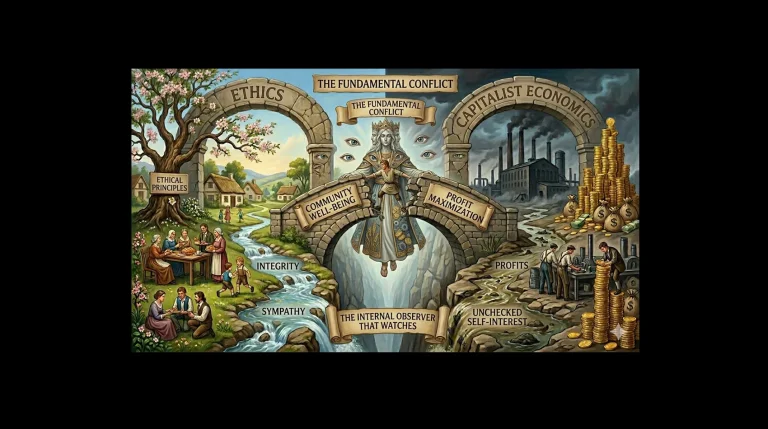
The confrontation between right and left is, in essence, a struggle between fragmentation and unity. Extreme individualism, by fostering atomization, displaces the love that should be directed toward human fraternity and redirects it toward the cult of matter.
Ontological Unity: Following Spinoza and Hermeticism, matter is a tool of Substance, not an object of personal property.
The Veil of Individuality: Selfishness is an illusion that prevents us from seeing our neighbor as a reflection of ourselves.
Compassion as Reality: Solidarity (Schopenhauer) is the recognition that we are all part of the same divine reality.
The Trap of Matter: Both economic systems based on unchecked accumulation and modern selfishness fail by ignoring that, in the end, matter belongs to no one — only to life itself, which seeks to express itself through it.
True progress, therefore, does not lie in the accumulation of form, but in the liberation of consciousness from matter, recognizing the other not as a competitor, but as a co-participant in the great dance of Substance.