The word “economist” did not even exist as we understand it today.
Formally, he was the Chair of Moral Philosophy at the University of Glasgow. For Smith, economics was not an isolated discipline, but a piece of a much larger puzzle he called the “science of the legislator.”
His vision was divided into three great interconnected areas:
Natural Theology: The study of the order of the universe.
Ethics: Which he captured in his Theory of Moral Sentiments.
Jurisprudence: The study of law and administration, from which The Wealth of Nations was born as an analysis of how laws and institutions affect prosperity.

The Philosopher Who Observed the World
What made him a special philosopher was his empirical approach. Unlike others who only speculated in the abstract, Smith analyzed real human behavior.
He understood that society is a complex system of human relationships.
His interest in the division of labor or the free market was not born of an obsession with money, but from a philosophical concern: How can a society of free individuals cooperate peacefully and prosperously without a tyrant forcing them to do so?
Ethics as the Foundation of the Market
It is a common historical error to read his economic philosophy without its moral foundation. Smith believed that:
1. Economic freedom is a natural right
2. However, that freedom only works if individuals possess self-control (virtue) and if the State guarantees justice.
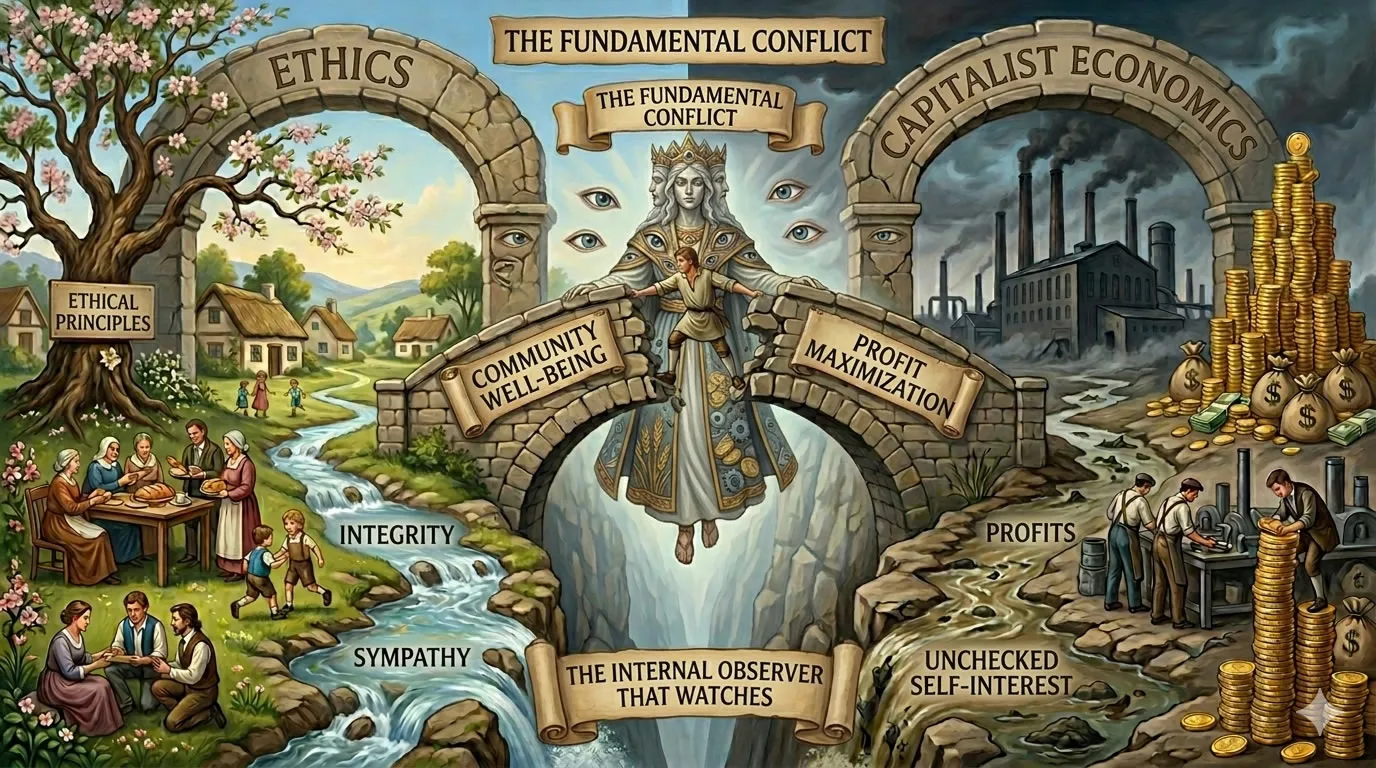
Without the foundation of moral philosophy, the “invisible hand” so often discussed today is left without the “arm” that supports it: trust and integrity between people.
It is curious that, centuries later, economics has become so technical that it sometimes forgets its original purpose was to answer an ethical question: what makes a life worth living in a community?
The Theory of Moral Sentiments (1759)
It is common to think of The Wealth of Nations (1776) as his definitive work, but for Adam Smith, his “second” great book—which was actually the first to be published—was the foundation of all his thought.
Even after the success of his economic treatises, Smith spent the rest of his life revising this philosophical work. Here are the central points of his thesis:
1. “Sympathy” (Empathy)
Smith did not believe that human beings were purely selfish. He argued that we have a natural principle that makes us interested in the fortune of others. He called this “sympathy” (what we would understand today as empathy): the ability to feel what another feels by putting ourselves in their place through imagination.
2. The Impartial Spectator
This is perhaps his most brilliant concept. Smith proposes that we all carry within us an “impartial spectator,” an internal voice that judges our actions not according to our desires, but as an objective and disinterested observer would. It is our moral conscience, telling us if something is fair or not, regardless of whether it benefits us economically.
3. The Search for Approval
For Smith, we do not work or accumulate goods solely for the object itself, but out of a desire to be observed, noticed, and approved of by others. The economy, therefore, is driven by a social and psychological need, not just a biological or material one.
4. Justice vs. Benevolence
He made a very clear distinction that remains relevant today:
Benevolence: An “ornament” of society. It is desirable for people to be good and charitable, but a society can survive without it.
Justice: The main “foundation.” Without justice (respect for the life and property of others), the fabric of society collapses immediately.
The Paradox of His Two Works
There is an academic debate called “Das Adam Smith Problem” which questions how the author of a book on empathy could write another on self-interest. However, the most accepted answer is that for Smith, there was no contradiction:
“It is not from the benevolence of the butcher… that we expect our dinner, but from their regard to their own interest.”
The Three Pillars of His Ethical Syste
1. Sympathy (The Social Glue): The faculty of sharing the emotions of others. We approve of another’s emotion if, by putting ourselves in their situation, we would feel the same. This connection ensures society is a network of affections rather than a jungle.
2. The Impartial Spectator (The Internal Compass): An abstract figure representing the gaze of society without personal prejudice. It acts as an internal judge: before acting, we ask ourselves if an objective observer would approve.
3. The Virtues (Order and Beauty):
Justice: The “negative” virtue (not harming others). The essential foundation.
Prudence: Care for our own health, fortune, and rank. It motivates us to improve our material condition.
Benevolence: Doing good to others. It makes society “beautiful,” though it is not strictly necessary for survival.
Self-command: The ability to control our impulses to act according to what the Impartial Spectator would approve.
Ethics Applied to Economics
Many believe Smith promoted unchecked selfishness, but his ethics say otherwise. For Smith, “self-interest” is only legitimate if exercised with prudence and within the limits of justice.
He believed the pursuit of wealth was an illusion that, while useful for human progress (keeping us active and creative), was not the source of true happiness.
For Smith, real happiness consisted of tranquility and being the object of legitimate love and admiration from others.
“Man naturally desires, not only to be loved, but to be lovely (worthy of being loved).”