Literature, Cultural
The Cave Experiment: Freedom, Inequality, and Human Passions

September 2, 2026
Share:
Freedom is one of the great ideals of modern philosophy. However, its mere proclamation does not resolve a deeper question: what does it truly mean to be free?
The previous chapter examined this question through the distinction between formal freedom and substantive freedom. The cave experiment demonstrated that extreme material inequality can transform into dependence; dependence, into power; and power, into a constraint on the real alternatives available to anyone lacking the necessary means for subsistence.
Yet material inequality does not operate in isolation. Between the possession of resources and human conduct lies an additional dimension: feelings, passions, and affects.
Fear, distrust, hope, empathy, selfishness, compassion, resentment, and the desire for dominion can profoundly alter the way two individuals respond to the very same material condition.
The experiment thus takes on a new dimension. We no longer ask solely what the person controlling the cave, the fire, and the food will do, but rather what takes place within them when compelled to decide how to act toward another human being whose survival depends on them.
Simultaneously, we must ask what occurs in the person who remains outside: what effects do fear, necessity, and dependence exert upon their freedom, their dignity, and their relationship with the one who controls the resources?
Inequality ceases to be merely economic. It is transformed into a psychological and moral relationship.
Thomas Hobbes, in Leviathan (1651), accords a foundational place to fear within human conduct. The fear of violent death constitutes one of the passions that impel individuals to seek conditions of peace and security. In the state of nature, Hobbes describes a condition marked by “continual fear, and danger of violent death,” a formula that illuminates the fragility of any cooperation when no common guarantee exists.
In the cave experiment, however, fear manifests differently in each individual.
The person outside fears dying of hunger, cold, or exposure. Their necessity is immediate, and their range of choice is exceedingly narrow.
The person inside can also experience fear: they may fear that the provisions will prove insufficient, that the stranger will attempt to seize the shelter, that future cooperation will falter, or that sharing today will undermine their own chances of survival tomorrow.
Real or perceived scarcity can thus feed distrust.
The philosophical dilemma arises when this fear ceases to function solely as a mechanism of self-protection and begins to justify dominion over the other.
The owner of the resources may reason: “I will help you, but on my terms.”
Help continues to exist, but its nature changes. It no longer constitutes an act of cooperation between equals; it can become the foundation of a hierarchical relationship.
The fear of loss can thus give rise to the desire to control.
Machiavelli, particularly in The Prince (1532), analyzes a political landscape where self-preservation, insecurity, fortune, and power dictate human decisions. Although his reflection belongs primarily to the political realm, it illuminates an essential dimension of the experiment.
The person in possession of the resources may interpret the vulnerability of the other not merely as a need warranting assistance, but also as an opportunity to consolidate their own position.
The relationship ceases to be governed exclusively by the moral question “should I help?” and begins to integrate another inquiry: “how does this person affect my security and my power?”
Distrust can turn the other into a potential threat even before any hostile act has been committed.
From this perspective, dominion can emerge as an instrument of security.
Yet precisely here lies the moral dilemma of the experiment: leveraging the vulnerability of another individual to augment one’s own power transforms a potentially cooperative relationship into one of subordination.
Spinoza provides a particularly vital framework for this second stage of the experiment.
In the Ethics (1677), affects occupy a central role in explaining human conduct. Human beings do not act solely through reason. Desires, fears, hopes, sadness, joy, hatred, and love continually modify our capacity to act and our relationship with others.
Spinoza defines bondage as “human lack of power in moderating and checking the emotions [affects].” This concept allows us to understand that a person can find themselves subjugated not only by an external force, but also by passions that diminish their capacity to act according to their own judgment.
From this vantage point, decisions within the cave cannot be explained strictly as a rational calculation regarding the distribution of food.
The material relationship between both individuals thus generates an affective dynamic.
This expands the experiment:
Inequality does not automatically produce domination.
Between inequality and domination lies a mediation composed of decisions, institutions, values, and affects.
Jean-Jacques Rousseau, in his Discourse on the Origin and Foundations of Inequality Among Men (1755), introduces another fundamental dimension: the transformation of material disparities into social relations of dependence.
When an individual controls that which another indispensable needs, inequality ceases to represent merely a quantitative difference.
It assumes a relational dimension.
One can impose conditions; the other must accept them.
Yet Rousseau also allows us to grasp how relationships with others alter our self-perception. Comparison, recognition, and social esteem begin to shape conduct.
Within the cave, therefore, it is not simply two biological necessities interacting. Two consciousnesses interact, observing, assessing, and emotionally reacting to one another.
The individual holding the resources may begin to perceive themselves as superior.
The dependent individual may experience gratitude, fear, humiliation, or resentment.
Material inequality can thus become psychological and social inequality.
The original three alternatives of the experiment can now be reexamined from the perspective of emotions.
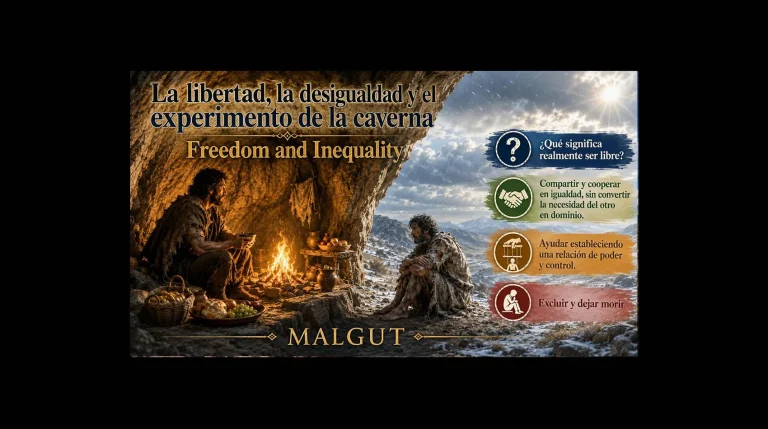
The first alternative consists of sharing the resources without turning the other’s need into an instrument of subordination.
This option requires overcoming, at least in part, fear and distrust.
Empathy enables the recognition of the other’s suffering. Reciprocity makes it possible to envision a relationship in which both can benefit from cooperation.
Trust makes it possible to partially abandon the defensive logic whereby any resource relinquished necessarily represents a loss.
Cooperation does not imply an absence of self-interest. Both can derive benefits.
The essential point is that neither deliberately exploits the vulnerability of the other to diminish their autonomy.
The second alternative is more complex.
The individual shares food and shelter, but demands a relationship of subordination in return.
Here, cooperation and domination appear simultaneously.
The outsider survives by virtue of the aid received, yet their survival remains conditional upon the will of the one controlling the resources.
Fear can play a dual role.
The one possessing the cave can use control to alleviate their own insecurity: obedience in exchange for protection.
The one outside may accept these terms out of fear of the consequences of refusing them.
Formally, consent exists. Substantively, however, the alternative may be starvation, freezing, or death.
Material inequality thus converts into power because it permits one individual to dictate the terms under which another may satisfy fundamental needs.
The third alternative consists of denying access to the resources entirely.
Here, indifference, apathy, or contempt can reach the point of nullifying moral recognition of the other.
The needy individual ceases to be perceived as someone whose life possesses a value comparable to one’s own; they become a stranger whose demise carries no obligation.
This alternative represents the extreme point of the breakdown of cooperation.
Exploitation does not exist here because not even a cooperative relationship exists: what exists is exclusion.
The experiment would remain incomplete if it analyzed solely the sentiments of the one controlling the resources.
The individual outside the cave also undergoes a psychological transformation, but furthermore confronts a practical trilemma: they must decide how to respond to a situation where every path entails risk.
The first possibility is to remain motionless and passively await death by starvation, cold, or exposure.
This choice might appear to be an absence of action, but it is not devoid of meaning.
It is the forced acceptance of impotence: the individual refrains from intervening because they perceive they lack the means to alter the situation.
Resignation can be accompanied by fear, hopelessness, and the progressive erosion of confidence in one’s own agency.
This is not necessarily a free choice. When alternatives have been reduced to the absolute minimum, inaction can be the consequence of a materially hollowed-out freedom.
The second possibility is to attempt to forcibly dispossess the occupant of their provisions and shelter.
This response mirrors the Hobbesian logic of the state of nature: every individual must rely on their own strength and regard the other as a potential threat to their survival.
The attack may resemble a reclamation of autonomy, but it carries a high risk of violent death for both.
Furthermore, hostility can validate the occupant’s fears and reinforce their decision to exclude or dominate.
Initial distrust thus becomes a self-fulfilling prophecy: each individual acts defensively and, in doing so, generates the very conditions that justify the defense of the other.
The third possibility is to approach unarmed, request sustenance, and attempt to negotiate an agreement.
This option opens the door to cooperation, but it also exposes the individual to rejection, humiliation, or subjugation.
A plea can articulate a legitimate need, even though material inequality situates it in an asymmetrical position.
The one who asks does not negotiate from full equality, because their very survival hinges on the other’s reply.
Even so, negotiation can transform the relationship. If both recognize that cooperation yields greater benefits than hostility, they can institute rules of access, distribution, and reciprocity.
A plea, therefore, does not inevitably culminate in servitude. It can serve as the first step toward an accord, provided assistance does not harden into a permanent condition of obedience.
The trilemma of the outside individual demonstrates that the dilemma is not solely psychological, but also strategic.
Each actor must make choices by anticipating the potential response of the other.
The occupant can share, dominate, or exclude. The outsider can resign, attack, or negotiate. The decisions of each alter the incentives and expectations of the other.
If both act out of pure distrust, the most probable outcomes are mutual destruction or domination.
An attack by the outside individual can trigger exclusion or violent defense by the occupant. Exclusion can drive the outsider to attack. Domination can secure immediate obedience, but also breed resentment and eventual rebellion.
Cooperation demands a qualitative leap: it is not enough for each individual to calculate immediate gain; both must embrace some degree of reciprocity and recognize that their own security depends on the security of the other.
In this sense, the situation shares a structure analogous to the Prisoner’s Dilemma. Distrust can lead to a suboptimal equilibrium for both, whereas cooperation yields a superior outcome — though it requires guarantees, communication, and a willingness to shoulder initial vulnerability.
The distinction is that here we do not find two prisoners insulated from each other’s decisions, but rather two individuals caught in a profoundly unequal material relationship.
Consequently, cooperation cannot be reduced to a symmetric exchange: it must incorporate safeguards that prevent the necessity of one from being turned into an instrument of domination for the other.
Initially, the outsider experiences fear.
Next comes the hope of receiving aid.
If assistance is conditioned upon obedience, submission can take hold.
If that subordination persists, humiliation may emerge.
And from humiliation, resentment can be born.
The relationship can thus unfold:
fear → hope → dependence → submission → humiliation → resentment.
Yet an alternative sequence can also develop:
fear → aid → trust → reciprocity → cooperation.
There is also a third possible sequence:
fear → distrust → attack → defense → violence.
The outcome is not governed exclusively by the quantity of provisions available. It depends equally on the manner in which both individuals forge their relationship and on the expectations each harbors regarding the conduct of the other.
This insight is fundamental.
The very same initial material inequality can yield radically divergent human relationships.
The experiment constitutes an ideal type and does not intend to equate disparate historical systems directly.
Nonetheless, it helps identify recurring mechanisms.
Slavery and various historical forms of serfdom combined material, legal, and psychological coercion.
Fear of punishment, dependence for subsistence, and the institutionalization of social hierarchies all contributed to reproducing those structures.
Feudalism likewise generated relationships of dependence tied to the land, protection, and personal obligation.
In modern capitalist societies, the situation is profoundly different because individual rights, labor markets, public institutions, and legal mechanisms exist that substantially broaden the range of choice.
Nevertheless, situations persist where extreme precarity, indebtedness, unemployment, or the lack of social safety nets curtail the alternatives effectively open to certain individuals.
This does not automatically render such relationships equivalent to slavery or serfdom.
The philosophical question is more precise: at what threshold does an economic dependence of sufficient intensity begin to significantly undermine a person’s real capacity to refuse terms dictated by others?
The question of the cave reemerges in modern guises.
The experiment makes clear that freedom does not depend solely upon the absence of prohibitions.
It also depends upon the material, psychological, and social conditions within which we choose.
A person dominated by fear may hold formal legal freedom and yet find the horizon of their choices severely constricted.
Yet this does not mean that feelings are the adversaries of freedom.
Empathy, trust, and solidarity are also affects.
The challenge, therefore, does not consist in purging emotions in favor of an abstract rationality.
It consists in understanding which sentiments expand our capacity to relate as autonomous agents, and which facilitate relations of domination.
The cave holds food and fire, but it also holds fear, hope, trust, and power.
The cave experiment demonstrates that material inequality does not operate in a vacuum.
Its consequences depend equally on the affects, perceptions, and decisions that structure the relationship between individuals.
Extreme inequality creates the potential conditions for dependence, but it does not inevitably mandate domination.
Faced with the vulnerability of the other, the individual may share, dominate, or exclude. The one remaining outside may resign, attack, or negotiate.
Fear and distrust can convert the vulnerability of another into an opportunity for control.
Indifference can lead to exclusion. Hostility can generate violence and mutual destruction. Yet empathy, trust, and reciprocity can orient the very same predicament toward forms of cooperation compatible with autonomy.
This introduces a fundamental conclusion:
The problem of freedom cannot be understood solely by asking who controls the resources. We must also examine what kind of human relationship arises around that possession, and what real alternatives each individual retains to respond.
Substantive freedom depends upon having real alternatives, but also upon living within relationships that recognize the other as an agent rather than merely an instrument.
The original question of the experiment — “is the person outside the cave free?” — thus assumes a new depth.
We must also ask:
What becomes of freedom when fear governs our decisions?
What becomes of cooperation when distrust turns the other into a threat?
What happens when the only way to ask for help is to accept a posture of inferiority?
And what kind of society emerges when the need of some becomes a source of power for others?
The cave experiment ceases to be merely a reflection on economic inequality.
It becomes a reflection on the affective and strategic architecture of power, and on the material and human conditions required for freedom to be genuinely realized.