Literature, Cultural
Freedom, Inequality, and the Cave Experiment

September 2, 2026
Share:
Freedom is one of the great ideals of modern philosophy. However, its mere proclamation does not resolve a deeper question:
What does it truly mean to be free?
Can a person be considered free if they possess no real means to say “no” to conditions imposed by whoever controls the resources they need to live?
This question links freedom, inequality, and power.
Inequality is not merely a disparity in goods or income; it can turn into dependency, and dependency into power.
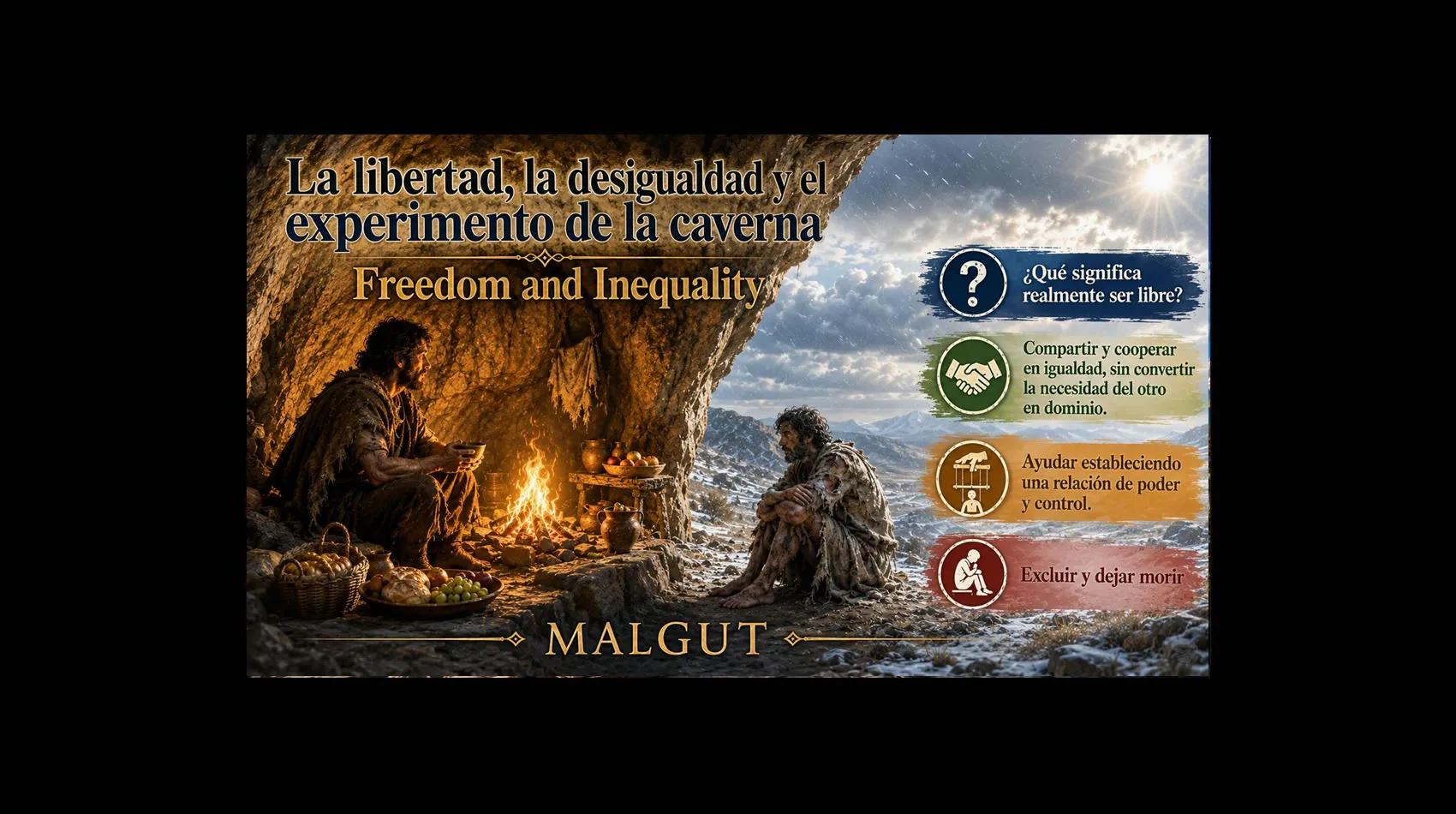
The cave experiment proposes a minimal scenario to observe this relationship:
Two human beings: one with shelter, fire, and sufficient food, and another with nothing.
If the second receives no help, they die.
There is no state, no laws, no money, and no corporations: only material asymmetry and two wills.
The cave dweller faces three alternatives:
A civilization from Andromeda observes the experiment. It knows nothing of our history, nor of concepts like capitalism or socialism; it seeks to understand our species from its most elemental relationships.
Their initial surprise is discovering that human beings can cooperate and dominate at the same time: they can offer aid while simultaneously using that aid as a source of subordination.
This observation breaks the simplistic dichotomy between selfishness and solidarity.
The central issue becomes the distribution of power within cooperation.
Thus emerges asymmetric cooperation: from another’s necessity, domination can be born.
This leads to the central question:
Is the individual outside the cave free?
Formally, they can refuse to enter; materially, however, that refusal is equivalent to death.
This tension between formal freedom and effective freedom bridges political philosophy, ethics, and economics.
Thomas Hobbes (Leviathan, 1651): Allows us to understand that in the absence of institutions, life is precarious and insecure. However, in our experiment, the primary problem is not anarchy, but the presence of a radical asymmetry of resources.
John Locke (Second Treatise of Government, 1689): Links property and freedom, but his notion of consent presupposes a certain symmetry of agency. If someone accepts extreme conditions solely to avoid death, the moral validity of that consent is compromised.
Baruch Spinoza (Ethics, 1677): Introduces the perspective that everything belongs to the common order of nature. Since matter is an expression of the single substance, no individual can absolutize private appropriation without committing an ontological fiction.
Jean-Jacques Rousseau (Discourse on the Origin of Inequality, 1755): Questions the sanctification of property when it turns into discretionary power. The experiment illustrates how an initial inequality of possession translates immediately into vital dependency.
Karl Marx (Capital, 1867): Analyzes how the monopoly over material conditions structures relations of exploitation. In the cave, the fundamental Marxian question arises: how free is a contract when one of the parties lacks real alternatives for subsistence?
Immanuel Kant (Groundwork of the Metaphysics of Morals, 1785): Radicalizes the ethical imperative: every person must always be treated as an end in themselves and never merely as a means. Forcing submission through necessity instrumentalizes the individual, violating their dignity and moral autonomy.
John Rawls (A Theory of Justice, 1971): Allows for evaluating the legitimacy of an agreement behind a veil of ignorance, where no one would accept as just an order that permits arbitrary subjugation in the face of extreme vulnerability.
Amartya Sen (Development as Freedom, 1999): Reformulates the contemporary debate by defining poverty not merely as an income shortage, but as a deprivation of basic capabilities to choose and realize valued life plans. Freedom is not a mere legal concession, but a substantive condition linked to real opportunities.
Definition of freedom: From a formal or negative perspective, freedom is reduced to the absence of direct physical coercion or explicit legal impediment. From a substantive or positive perspective, it demands the real, material capacity to choose among viable alternatives.
Value of consent: The formal approach considers valid any voluntary agreement in which direct physical violence is absent. The substantive approach warns that consent is vitiated when the only available alternative is destitution or death.
Function of resources: While the formal framework conceives goods as objects of exclusive and unquestionable possession, the substantive framework understands them as enabling conditions essential for the effective exercise of agency and dignity.
Role of institutions: The formal perspective limits the institutional role to the unrestricted protection of acquired property. In contrast, the substantive perspective demands designing institutions that prevent material asymmetry from turning into relations of servitude.
If we use the experiment’s three options as ideal types, we can examine history without forcing exact equivalences.
Ancient and modern slavery approaches the extreme of cooperation under total coercion. Survival exists, but autonomy is legally and socially nullified.
Feudalism, with its forms of serfdom, illustrates another modality of structural dependence.
The serf is not property in the same sense, but their existence is bound to the land and to personal obligations that severely restrict their freedom of movement and choice.
In capitalist modernity, coercion is often less direct, yet forms of dependency can persist through bare subsistence wages, chronic debt, or a lack of social safety nets.
It is not identical to slavery, but the question of how free someone truly is when they have no effective alternatives… re-emerges.
At the same time, history also records efforts to expand substantive freedom.
The abolition of slavery, labor rights, social security, public education, and other institutions can be read as partial attempts to break chains of extreme dependency.
From this viewpoint, history is not a single line, but a contested terrain over the extent to which necessity can be converted into power over others.
The cave experiment does not seek to define an immutable human essence, but rather to model a recurring mechanism: extreme inequality engenders dependence, and dependence empties freedom of its content.
From a normative perspective, the focus does not lie solely on the quantity of resources possessed, but on the relationships of subordination that emerge from their exclusive control.
If poverty deprives individuals of the minimum thresholds needed to decide their own lives, it constitutes a direct restriction on freedom.
Social justice cannot be limited to guaranteeing biological subsistence; it must dismantle the systems of domination that reduce autonomy to a formal fiction.
The fundamental question is not merely “who owns the cave?”, but under what institutional and ethical conditions a coexistence that preserves the dignity and effective freedom of all is possible.