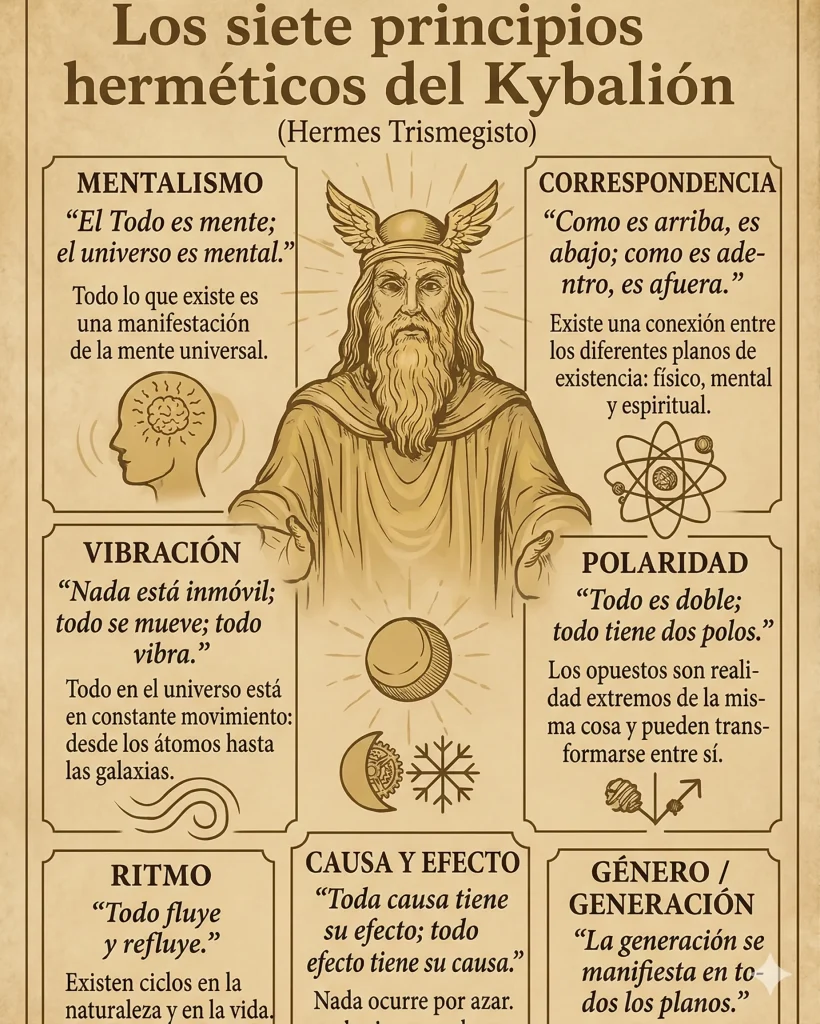
1.The Principle of Mentalism: What it consists of: It states that “All is Mind; the Universe is mental.” Everything that exists is a creation of the universal mind, and your thoughts construct your reality. Examples: a) Visualization. b) The impact of beliefs on health. c) The manifestation of ideas in the physical world.
2.The Principle of Correspondence: What it consists of: It expresses that “As above, so below; as below, so above.” It reflects the harmony and connection between all planes of existence. Examples: a) The structure of the atom is similar to that of the universe. b) The impact of individual actions on the collective. c) The patterns of nature that repeat themselves at different scales.
3.The Principle of Vibration: What it consists of: “Nothing is at rest; everything moves; everything vibrates.” Everything in the universe is in constant motion and possesses a specific vibrational level. Examples: a) Energy and matter are different levels of vibration. b) Emotions have different vibrational frequencies. c) Sound and light as manifestations of vibration.
4.Principle of Polarity: What it consists of: “Everything is dual; everything has poles… opposites are identical in nature, but different in degree.” It postulates that everything has two opposing but interconnected aspects. Examples: a) Light and darkness, cold and heat, love and hate are extremes of the same scale. b) Duality in human nature. c) The search for balance between work and rest.
5.Principle of Rhythm: What it consists of: “Everything flows out and in; everything has its periods of advance and retreat.” It describes the constant pendulum-like movement in existence. Examples: a) Economic cycles of boom and bust. b) The seasons of the year. c) Moods with their ups and downs.
6.Principle of Cause and Effect: What it consists of: “Every cause has its effect; every effect has its cause.” It establishes that there is no such thing as chance, but rather an unbroken chain of causes and consequences. Examples: a) The decisions you make (cause) determine your future. b) The effort invested in learning (cause) leads to success. c) Positive actions generate positive results.
7.Principle of Generation: What it consists of: “Generation has poles; everything has its masculine and feminine principle.” It manifests on all levels as a creative principle. Examples: a) The masculine and feminine principles (Yang and Yin). b) Duality in nature. c) Creativity that arises from the union of ideas.